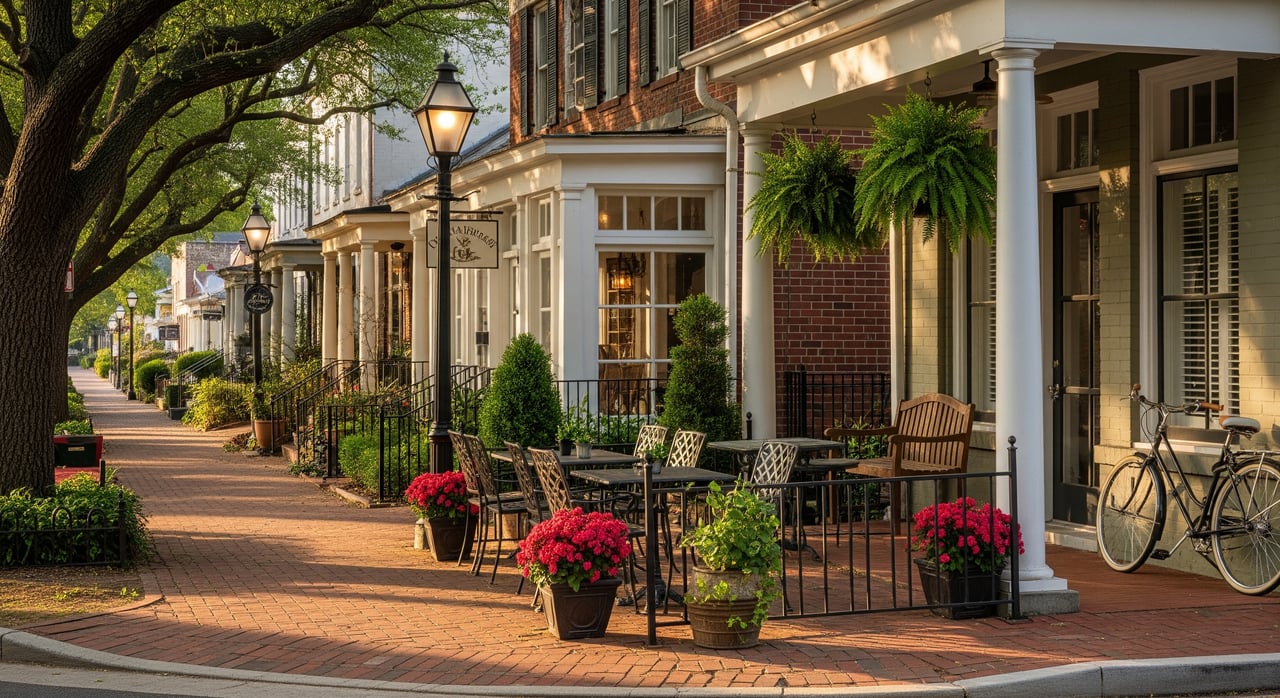
Walk North Highland Avenue through Morningside Village this month and you will see ladders against the awnings at Doc Chey's, drop cloths outside the Family Dog, and a mural taking shape on a wall that has been blank brick since most of these buildings went up. It looks like renewal. It is not the kind of renewal this stretch of Atlanta has learned to brace for.
For years, the story of intown retail districts near the BeltLine has been the same one, repeated with different developer names: a longtime commercial strip gets bought, the tenants get notices to vacate, and what reopens eighteen months later bears no resemblance to what closed. Morningside Village is taking the opposite path. Its owner, the Atlanta real estate investment firm 26th Street Partners, is spending money to make the place look more like itself, not less.
What's Actually Changing
The scope of the work, according to plans the firm shared with the Atlanta Journal-Constitution, is cosmetic and functional rather than structural. The roughly 50,000-square-foot property that straddles North Highland is getting:
- New exterior lighting and landscaping
- Fresh paint and awnings across the buildings
- Artist murals on select walls
- Improved wayfinding signage
- Distinct crosswalks meant to visually tie the scattered buildings into one walkable district
That last point matters more than it sounds. Morningside Village has never read as a single place. It is a collection of buildings that happen to share a sidewalk, and anyone who has tried to walk from Doc Chey's to Highland Fine Wine at dusk knows the crossings feel like an afterthought. Defined crosswalks and better lighting are a small fix for a real problem, and they are the kind of infrastructure detail that shows up in a permit filing, not a press release.
The Doc Chey's Test
The clearest signal of intent is who is staying. Doc Chey's Noodle House has occupied its spot in the Village for almost 30 years, long enough to outlast several ownership changes on the block. It is not going anywhere during this renovation. Neither is Whiskey Bird, the Family Dog, Highland Fine Wine, Highland Runners, or Intown Animal Hospital, the six businesses named specifically in the ownership's own description of the project.
That is a meaningful list because it is a boring one. None of these are the kind of national or regional concept a developer typically installs to signal a strip has been upgraded. They are neighborhood fixtures, the sort of businesses residents build actual routines around: the running store where you replace shoes twice a year, the vet three blocks from home, the wine shop that knows what you bought last time. A renovation built around keeping those tenants in place is a bet that the value in Morningside Village was never the buildings. It was the roster.
Enter Alere
The one real newcomer is worth naming precisely because it breaks the pattern in an interesting way. Chef Christopher Grossman, whose Buckhead restaurant The Chastain has built a following over the past several years, announced in June that his next concept, called Alere, will open in the Village in 2027. The space at 1397 North Highland Avenue has some recent history: over the past decade it has been Morningside Kitchen, then Nowak's, then a pivot to its current identity as Nowak's Cantina. Grossman is working with Summerour Architects and Smith Hanes Design on the buildout, and the restaurant is described as drawing on Southern European cooking with a seasonal, ingredient-driven menu built around locally sourced ingredients.
So even inside a story about stability, one storefront keeps turning over. That single address has now cycled through three concepts in roughly a decade while the businesses around it stayed put for three times as long. It is a useful reminder that "the Village isn't changing" and "nothing in the Village ever changes" are two different claims. The first is true. The second was never the point.
Nearby, a Different Kind of Change
The contrast gets sharper if you look at what is happening nearby, where Amsterdam Walk sits between Piedmont Park and the BeltLine's Northeast Trail, on property that straddles the Virginia-Highland and Morningside-Lenox Park neighborhood lines. That 11-acre former warehouse district, home to local businesses since the 1990s, has spent more than two years in a fight over its future. Developer Portman Holdings pushed a plan that started at 900 apartments, up to 400,000 square feet of office space, and buildings as tall as 17 stories. After sustained pushback from the Virginia-Highland Civic Association and the Morningside Lenox Park Association, including a yard-sign campaign and a contested City Council vote that passed 8 to 6 in April 2025, the project was scaled back by roughly 21 percent. New filings this spring show phase one moving forward with 666 apartments, with the residential piece expected to take about two years to build and open sometime in 2028.
Amsterdam Walk and Morningside Village share a neighborhood association, and longtime residents have watched both processes unfold at the same time. The difference in approach is not subtle. One developer is trying to remake a commercial district into something denser. The other is trying to keep a commercial district recognizable while making it function better. Residents who spent two years reading Amsterdam Walk traffic studies and zoning notices now get to watch a much quieter kind of change happen right in their own retail strip, and the quiet is the point.
The Park Committees Are Doing the Same Thing
The same instinct shows up in how the neighborhood treats its parks, and it predates the Village renovation by years. Smith Park, at the corner of Piedmont Road and Monroe Drive, was set aside in 1932 to honor developer James Robert Smith and has stood as one of the neighborhood's main entrances ever since. When its fountain fell into disrepair, the fix did not come from the city. It came from Sherwood Road residents, who kicked off fundraising with a block party in March 2015 that raised more than $4,000 from neighbors and nearby businesses, enough to get a design approved and the fountain restored.
Sidney Marcus Park has a similar story with higher stakes. The property had originally been condemned and assembled decades earlier to make way for a planned interstate, I-485, that would have run straight through the middle of Morningside. Five Morningside women, Mary Davis, Virginia Taylor, Barbara Ray, Adele Northrup, and Virginia Gaddis, led the neighborhood fight that stopped the freeway, and in 1985 the land was dedicated as a city park instead, named for Sidney J. Marcus, the Georgia legislator who had opposed the road first as MLPA chairman and then as a state representative. The volunteer group Friends of Sidney Marcus, known as FoSMP, formed in May 2017 and has spent the years since addressing the park's drainage and erosion problems in partnership with Atlanta's Department of Parks and Recreation, Park Pride, and landscape architecture firm SITE Solutions. FoSMP recently launched a new capital campaign to fund the next phase of that work.
None of these projects are glamorous. A restored fountain and a drainage fix will not show up in a listing photo. But they are the same civic muscle at work that is now steering the Village renovation: when something in this neighborhood needs fixing, the instinct is to repair it and keep using it, not to tear it down and start over.
What This Adds Up To
If you live in Morningside or Lenox Park, the takeaway is not that a shopping strip is getting new paint. It is that you are watching a neighborhood make a choice, repeatedly, about what kind of change it wants. The Village facelift, the Smith Park fountain, the Sidney Marcus drainage campaign, and even the neighborhood associations' fight over Amsterdam Walk's scale are all versions of the same argument: keep what works, fix what doesn't, and be selective about what gets added. That argument does not always win. It won at Amsterdam Walk only after more than two years of organizing. But at Morningside Village, for now, it did not have to fight for a single vote. The owner made the same call the neighborhood usually has to force.
Next time you are picking up noodles at Doc Chey's or dropping a dog at the vet next door, look up at the scaffolding. It is not covering something new. It is holding up something the neighborhood already decided was worth keeping.
If you are curious how these changes are showing up in what homes in Morningside and Lenox Park are actually selling for this year, Molly Carter Gaines tracks both the market and the neighborhood's day-to-day shifts closely and is always glad to talk through what she's seeing on the ground.